

So, you’ve finally decided to trade your sneakers for dance shoes and sign up for a class?
That is awesome.
But stepping into a western dance studio for the first time is an absolute rush.
That’s because those first few lessons can feel a bit like trying to solve a Rubik’s Cube while balancing on a tightrope. It’s totally normal to feel like your feet have developed a mind of their own.
The good news? Most beginners make the exact same mistakes. If you can spot these five common stumbles early on, you’ll find yourself gliding across the floor with way more confidence
Table of Contents
1. The “Magnet Feet” Syndrome
This is the number one rookie move. Because you’re concentrating so hard on where your feet are supposed to go, your chin naturally drops to your chest. You spend the whole song staring at your laces.
Why it’s a problem: In any Western dance style, your posture is your power. When you look down, your spine collapses, your balance shifts forward, and you lose that crucial connection with your partner. Plus, let’s be honest: it’s hard to look cool when you’re staring at the floor like you lost a contact lens.
- The Quick Fix: Keep your eyes up! Pick a spot on the wall at eye level or look at your partner’s shoulder. Trust your feet, they know what to do without you supervising them.
2. The “Statue” Stance (Holding Your Breath)
When we get nervous or hyper-focused, we tend to hold our breath. You might not even realise you’re doing it until you finish a 30-second basic step and feel like you just ran a marathon. This tension travels straight to your shoulders and arms, making your movement look stiff and robotic.
Why it’s a problem: Dance is supposed to be fluid. If you’re tensed up, you can’t react to your partner’s lead or follow the rhythm. You become “heavy” to dance with, and the joy gets sucked right out of the room.
- The Quick Fix: Just breathe. Seriously. Take a deep exhale, consciously drop your shoulders away from your ears, and this is the magic trick smile! It’s physically harder for your body to stay rigid when you’re smiling.
3. Trying to Run Before You Can Two-Step
We’ve all seen the pros doing those cinematic dips, fast spins, and complex aerials. It’s tempting to ask your instructor at a western dance studio to “show us the cool stuff” on day one. But jumping into advanced patterns before you’ve mastered the “Box Step” or the basic “Triple Step” is a recipe for sloppy habits.
Why it’s a problem: A fancy spin built on a shaky foundation is going to look messy and feel unsafe. The most impressive dancers aren’t the ones doing the most moves; they’re the ones doing the basic moves with perfect technique.
- The Quick Fix: Fall in love with the fundamentals. Drill your basic steps until you can do them in your sleep. Once the basics are muscle memory, the “cool stuff” will actually feel easy.
4. Being “Beat-Blind.”
Sometimes beginners get so caught up in counting, “One, two, three, four!”, that they stop actually listening to the song. They end up dancing to the music rather than with it.
Why it’s a problem: If you ignore the rhythm, your dancing loses its soul. You might be doing the right steps, but if you aren’t hitting the “1” count, you and your partner will eventually drift apart like two ships in the night.
- The Quick Fix: Before you even start moving, take a second to just stand and feel the beat. Tap your toe or nod your head. Try to find the heavy “downbeat” (the 1). If you can hear the music first, your feet will follow much more naturally.
5. The “Wrestling Match” (Forceful Leading/Following)
In partner-heavy western dance style categories like Foxtrot or Swing, there’s a delicate conversation happening through the hands and frame. Beginners often overcompensate by “muscling” their partner around or “anticipating” what’s coming next and jumping the gun.
Why it’s a problem: Leading isn’t about pushing; it’s about inviting. Following isn’t about guessing; it’s about responding. When you use too much force, you end up clashing with your partner, which usually leads to a lot of “Sorry!” and “My bad!” mid-song.
- The Quick Fix: Use light, subtle signals. Think of it like a gentle suggestion rather than a command. If you’re following, wait until you actually feel the lead before you move.
The Beginner’s Cheat Sheet
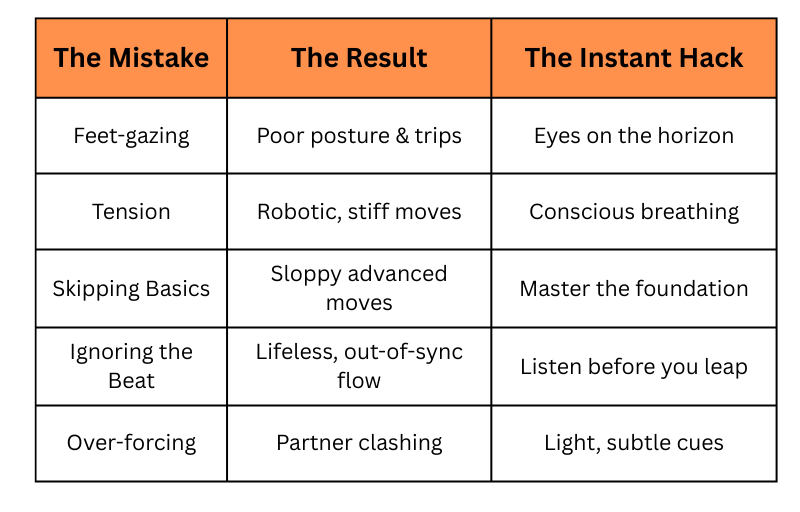
Practice Makes… Fun!
At the end of the day, every pro was once a beginner who felt like they had two left feet. The key is to stay patient and keep showing up.
If you focus on these five areas, you’ll be amazed at how quickly you stop feeling like a “student” and start feeling like a dancer.